
Concrete Repair Lake Worth Beach: When to Repair vs. Replace
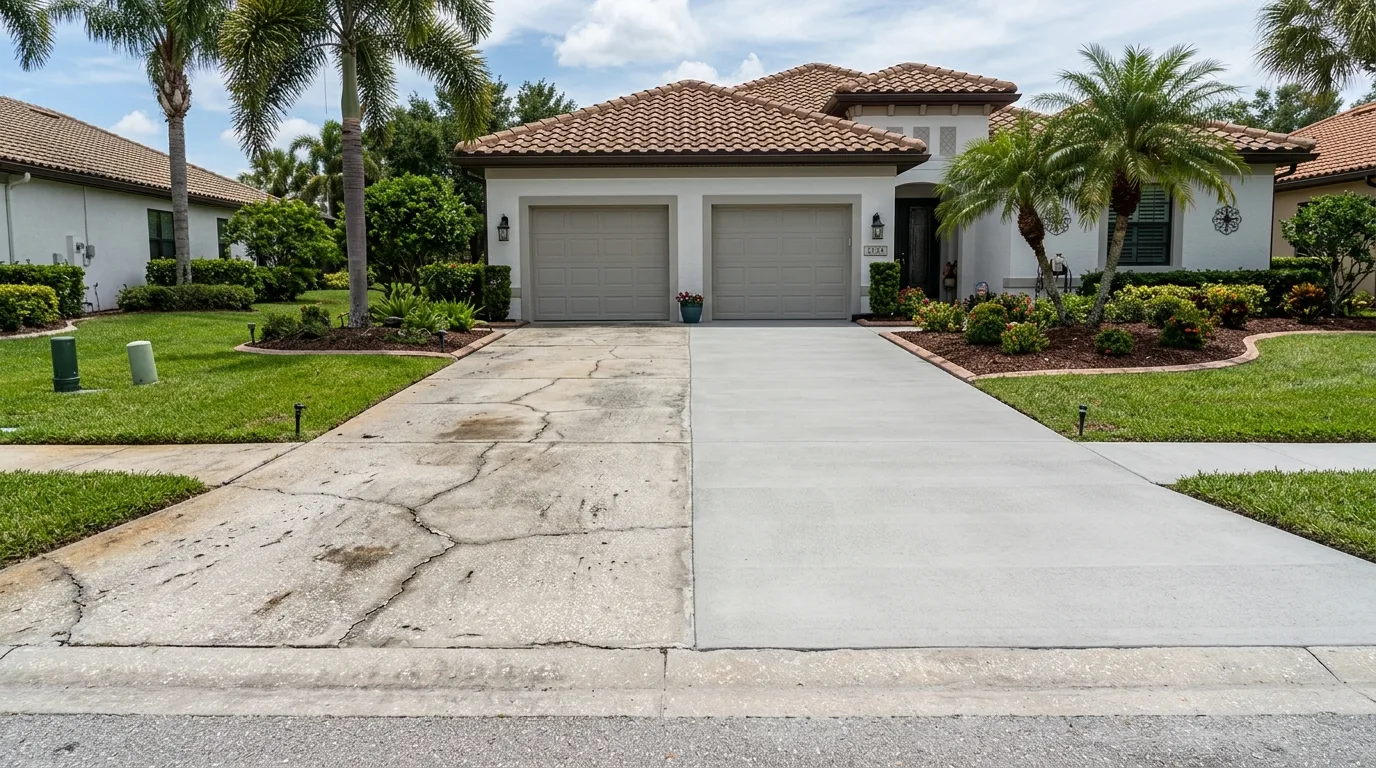
The crack running across a Lake Worth Beach driveway slab has two possible meanings: it’s a normal shrinkage crack that can be filled and forgotten, or it’s a sign of structural movement in the subbase that will defeat any repair within one wet season. These look similar to the untrained eye and require completely different responses. Making the wrong call — filling a structural crack without addressing the root cause, or replacing a slab that could have been repaired — costs Lake Worth Beach homeowners real money. This guide gives you the assessment framework to tell the difference.
Free Concrete Assessment in Lake Worth Beach
We tell you honestly whether repair or replacement is the right call. Call (888) 376-0955.
Why Concrete Repair Decisions Are Different in Palm Beach County
Lake Worth Beach’s expansive clay soils make the repair-vs-replace decision more complex than it is in most markets. In a stable soil environment, a crack is usually a surface issue — the concrete shrunk, moved slightly, or was subject to thermal expansion, and the crack itself is the extent of the problem. In Palm Beach County, cracks are often a symptom of soil movement beneath the slab: clay that expanded during the wet season, then contracted and left a void during the dry season.
A repair applied to a crack caused by void-driven slab flexing will fail within 1–2 rainy seasons. The crack opens again because the soil is still moving. The right repair in this scenario addresses both the crack and the underlying cause — whether that’s void filling with mudjacking, drainage correction to prevent soil saturation, or subbase replacement if deterioration is severe enough. A contractor who fills the crack without investigating its cause is setting you up for repeated repairs.
Types of Concrete Damage — Repair vs. Replace Assessment
Hairline cracks (under 1/8 inch): Almost always repairable. These are typically shrinkage cracks that formed during the cure period. They should be sealed to prevent water infiltration but don’t indicate structural problems. In Lake Worth Beach driveways and patios, hairline cracks are normal on any slab older than 5 years.
Moderate cracks (1/8–1/4 inch): Usually repairable if the crack edges are stable (not displaced) and the slab sections on either side are at the same height. Fill with flexible polyurethane and seal. If the crack edges are displacing vertically — one side is higher than the other — the cause is likely soil movement, and repair alone won’t hold.
Wide cracks (over 1/4 inch) or actively growing cracks: Require investigation before repair. Wide cracks allow water infiltration that accelerates subbase erosion in Lake Worth Beach’s rainy season. If the crack is growing (photograph it over several months to confirm), the underlying cause must be identified and addressed before any surface repair is attempted.
Spalling (surface layer breaking away): In most cases, repairable with a polymer-modified mortar overlay if the concrete beneath the spalled area is intact. If spalling covers more than 30–40% of the slab surface, full resurfacing or replacement is more cost-effective. Spalling on pool decks throughout South Palm Park is common due to UV degradation and pool chemical exposure — typically addressed with full deck resurfacing.
Settlement (slab sections at different heights): Slab sections that have settled more than an inch below grade create trip hazards and drainage problems. Mudjacking (pumping grout beneath the settled section) can lift it back to grade if the subbase void is the primary cause. If the slab has fractured extensively or the subbase is eroded throughout, replacement is more cost-effective.
Full-depth cracking throughout the slab: Replacement. When cracking runs through the full depth of the concrete in a network pattern, the slab has failed structurally. Patching prolongs the problem without solving it.
Cost Comparison: Repair vs. Replace in Lake Worth Beach
Crack filling: $200–$500 for isolated minor repairs. Cost-effective whenever repair is genuinely the right solution.
Surface resurfacing overlay: $3–$7 per square foot for a slab that’s structurally sound but cosmetically worn. A 600-square-foot driveway resurfacing runs $1,800–$4,200.
Mudjacking: $500–$1,500 per settled residential section. Appropriate when voids beneath a sound slab are causing settlement.
Full replacement: $6–$9 per square foot for plain concrete in Lake Worth Beach, plus $2–$4 per square foot for demo and disposal. A 600-square-foot driveway replacement runs $4,800–$7,800 total.
The break-even point: when repair costs plus expected reoccurrence costs over 5 years exceed replacement cost, replacement is more economical. Repeated patching of a structurally moving slab in Sunset Ridge will exceed driveway replacement cost within 3–4 repair cycles.
Practical Damage Scenarios in Lake Worth Beach
- Driveway in Mango Groves with two parallel cracks: If the cracks are closed (not displaced vertically), same-level edges, and stable over 3 months of observation — repair. Fill with flexible polyurethane and seal.
- Patio in College Park with widespread surface spalling: If the underlying slab is solid when tapped (hollow sounds indicate delamination) and drainage is adequate — resurface. Stamped overlay restores appearance and adds years of life.
- Pool deck in Parrot Cove with peeling cool deck coating: Repair (resurfacing). Remove the failed coating, prep the surface properly, and apply a new pool deck overlay system. This is a cosmetic issue, not a structural one.
- Driveway section in Old Lucerne that rocks when walked on: Mudjacking or replacement. The rocking indicates a void beneath the slab — mudjacking fills the void and stabilizes; replacement is appropriate if the slab is also fractured extensively.
Frequently Asked Questions
How do I know if my concrete crack is structural or cosmetic?
The key indicators of structural cracking are: vertical displacement at the crack edges (one side is higher than the other), the crack is growing over time, the slab rocks or shifts near the crack, or water pools at the crack location after rain. Cosmetic cracks are level at both edges, stable over time, and don’t affect slab movement. If you’re unsure, contact us for a free concrete assessment in Lake Worth Beach.
How long does concrete repair last in Palm Beach County?
Done correctly — with the underlying cause addressed — crack repairs in Lake Worth Beach last 5–15 years. Resurfacing overlays on structurally sound slabs last 7–12 years with resealing every 2–3 years. Repairs that don’t address the root cause (drainage failure, void formation) fail within 1–2 rainy seasons. The quality of the repair is determined by diagnosis as much as by the repair material.
Is concrete repair cheaper than replacement in Lake Worth Beach?
For surface-only and isolated crack damage: yes, repair is significantly cheaper. For slabs with widespread structural failure, extensive void formation, or poor drainage that makes repair materials fail repeatedly: replacement, though more expensive upfront, is cheaper over 5–10 years than repeated repair costs. We provide an honest assessment during the free consultation — we don’t recommend replacement to sell a larger job.
Get an Honest Concrete Assessment in Lake Worth Beach
We diagnose the cause before recommending a fix. Free assessments, written estimates. Call (888) 376-0955.
Related: