
Concrete vs. Pavers in Lake Worth Beach: Which Is Better?
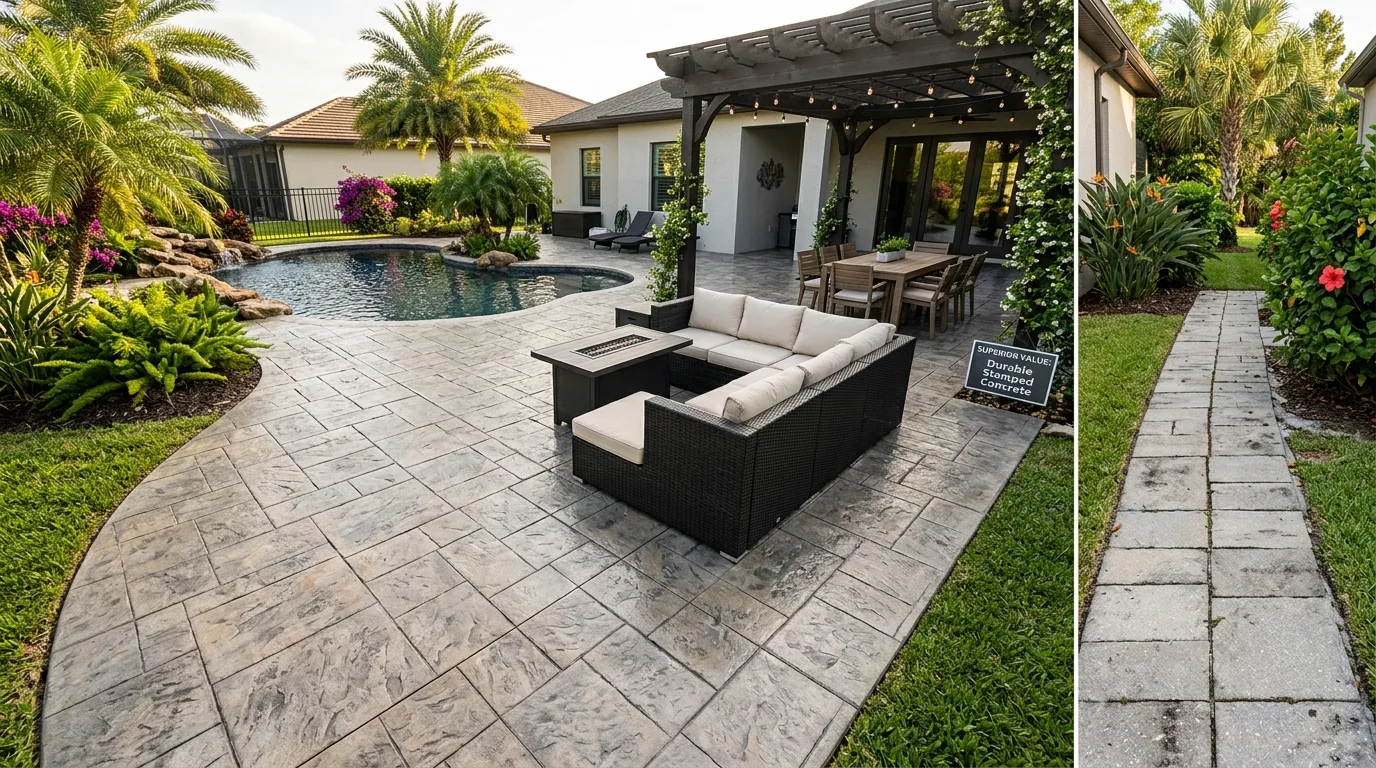
The most common material debate among Lake Worth Beach homeowners planning a driveway or patio upgrade is concrete versus pavers. Both materials have genuine advocates. Paver manufacturers emphasize repairability and design flexibility; concrete contractors emphasize durability and total cost of ownership. The choice for a Lake Worth Beach homeowner is complicated by factors that don’t apply in most other markets: expansive clay soils that cause pavers to shift more aggressively than elsewhere, intense UV exposure that affects both materials differently, and South Florida’s rainy season that tests drainage design on every surface. This guide gives you an honest comparison.
Free Estimate on Concrete or Pavers in Lake Worth Beach
We help you choose the right material for your site, budget, and neighborhood. Call (888) 376-0955.
Why This Decision Is Different in Palm Beach County
Most concrete vs. pavers comparisons use data from Midwest or Northeast markets — climates that are fundamentally different from Lake Worth Beach’s conditions. In cold climates, pavers have an advantage over concrete because freeze-thaw cycles crack concrete repeatedly while individual paver units survive. In South Florida, freeze-thaw is essentially irrelevant. The relevant factors are different: how each material handles clay soil movement, how each performs under intense UV, and how each requires maintenance through repeated rainy seasons.
The honest answer for Lake Worth Beach: concrete outperforms pavers on durability, maintenance requirements, and total cost of ownership in South Florida conditions. Pavers outperform concrete on repairability of localized damage and on the flexibility of being adjustable after installation if utility work requires access. Both are viable; the right choice depends on your budget, aesthetic goals, and tolerance for ongoing maintenance.
Cost Comparison in Lake Worth Beach
Concrete driveway: $6–$9 per square foot for plain broom finish, $12–$18 per square foot for stamped. A 600-square-foot two-car driveway runs $3,600–$5,400 plain or $7,200–$10,800 stamped.
Concrete paver driveway: $15–$25 per square foot installed in Palm Beach County, depending on paver type (concrete pavers vs. natural stone). A 600-square-foot driveway runs $9,000–$15,000 for standard concrete pavers and $12,000–$20,000+ for natural stone.
Initial cost advantage: Concrete, significantly. Plain concrete is roughly half the installed cost of pavers. Even stamped concrete is typically less expensive than comparable quality paver installation in Lake Worth Beach’s market.
Long-term maintenance cost: This is where the comparison shifts. Pavers require annual polymeric sand replacement in the joints — in Lake Worth Beach’s humid environment, joint sand is displaced by rain and colonized by weeds and ant activity more aggressively than in drier climates. Professional sand replacement runs $1–$2 per square foot annually, adding $600–$1,200 per year for a 600-square-foot driveway. Concrete maintenance (sealing every 2–3 years) costs $300–$600 total.
Durability in Lake Worth Beach’s Climate
Concrete in Clay Soil Conditions: Properly prepared concrete driveways in Lake Worth Beach last 30–40 years. The key is adequate subbase preparation — removing expansive clay, installing compacted fill, and designing drainage correctly. Without this preparation, concrete in inland neighborhoods like Sunset Ridge cracks prematurely regardless of material quality.
Pavers in Clay Soil Conditions: Pavers on clay soils in Palm Beach County are prone to shifting and settling, particularly along driveway edges where vehicle loads apply repeated stress. Individual paver units can be reset after settling, but the need for resetting recurs more frequently in expansive clay than in stable soil environments. Homeowners in Old Lucerne and Mango Groves with paver driveways on clay subbase typically need professional resetting every 3–5 years.
UV and Surface Fading: Concrete sealers need renewal every 2–3 years in South Florida’s UV environment. Pavers’ natural material color holds better than sealer-dependent concrete finishes, but concrete pavers (as opposed to natural stone) fade similarly to plain concrete. Stamped concrete with premium UV-stabilized sealers maintains color well with regular maintenance.
Practical Scenarios: When Each Material Makes Sense
Choose concrete when:
- Budget is a primary consideration (concrete is significantly less expensive)
- You want a low-maintenance surface that doesn’t require annual joint sand replacement
- Your site has active clay soil that requires engineered base preparation — you’re already investing in the subbase, might as well commit to concrete
- You want the option for decorative stamped finish at a price point below paver alternatives
- You’re in a neighborhood where the resale buyer pool expects concrete (most of Lake Worth Beach)
Choose pavers when:
- Utility lines run under the driveway area and future access for repair may be needed
- You have the budget for premium natural stone that concrete can’t replicate
- Localized damage repair is more likely (high-traffic commercial applications)
- Your HOA or neighborhood aesthetic standards specifically require pavers
Types of Pavers and How They Compare in Lake Worth Beach
Concrete interlocking pavers: The most common and most affordable paver option in Palm Beach County ($15–$18/sq ft installed). Durable but subject to color fading in UV exposure and joint maintenance in South Florida’s climate.
Travertine pavers: Natural stone, very popular in the Lake Worth Beach luxury market. Naturally cooler underfoot than concrete in full sun. Costs $20–$30+ per square foot installed. Requires sealing to prevent staining and chloride penetration in coastal locations.
Brick pavers: Less common in South Florida due to cost and availability. Traditional aesthetic suits Lake Worth Beach’s historic neighborhoods but carries high material costs.
Frequently Asked Questions
Is concrete or pavers better for pool areas in Lake Worth Beach?
For pool decks in Lake Worth Beach, stamped concrete or concrete overlay systems generally outperform pavers. Pavers around pools allow pool chemical seepage between joints, which stains and deteriorates the joint material and the paver substrate. Concrete provides a seamless, cleanable surface that handles chlorine exposure better. Cool deck overlay systems specifically engineered for pool environments are not available for paver applications.
Can I install pavers over an existing concrete driveway in Lake Worth Beach?
Yes, but with important caveats. The existing concrete must be structurally sound and the grade must be high enough to accommodate the paver height without affecting drainage or entries. Adding pavers over an existing slab also eliminates the most-cited benefit of pavers — the ability to access subsurface utilities by removing individual units. In Lake Worth Beach, this approach is sometimes used for aesthetic upgrades but isn’t the standard application.
Do pavers or concrete hold up better in Lake Worth Beach’s hurricane-prone climate?
Both perform similarly in hurricane conditions. Neither material is typically damaged by wind itself. The risk is debris impact and storm surge flooding. Concrete is generally easier to clean and restore after a major flooding event, as individual concrete slabs can be inspected and replaced if structural damage occurs. Neither pavers nor concrete provides meaningfully different hurricane protection.
Concrete Driveways and Patios in Lake Worth Beach
Free estimates on plain, stamped, and decorative concrete for driveways, patios, and pool decks. Call (888) 376-0955.
Related: